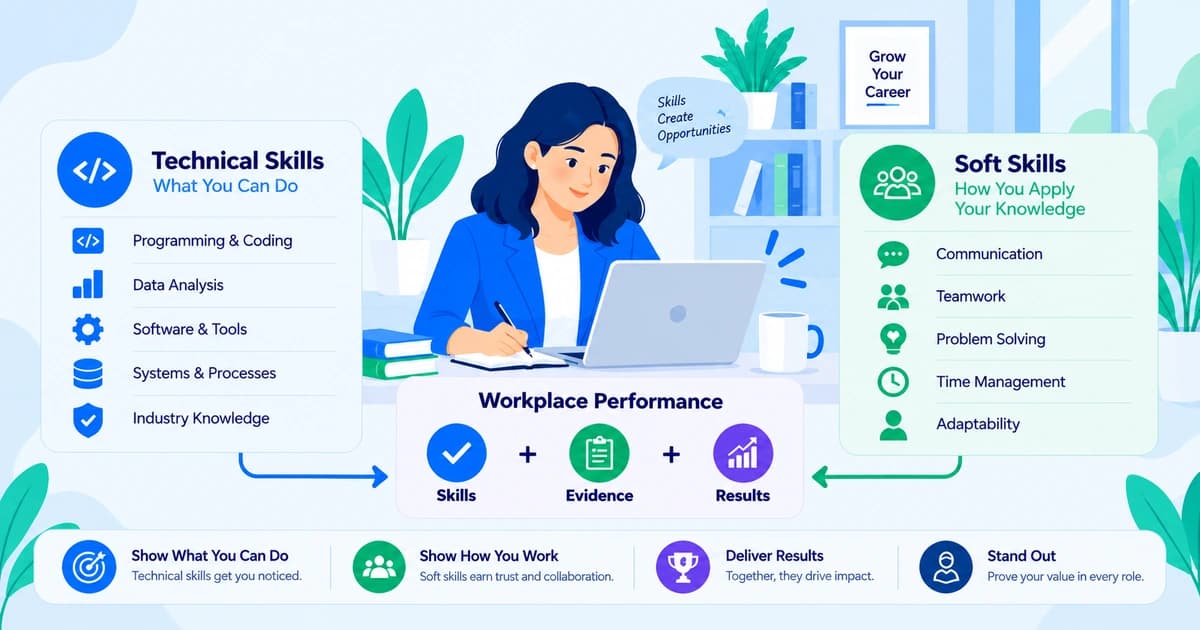
Technical qualifications may qualify you for a role, but soft skills
influence how effectively you apply them. In today's competitive job
market, hiring managers also assess personal attributes and
interpersonal skills such as communication, judgment, adaptability, and
reliability. The right combination can make all the difference between
meeting the requirements and showing that you can succeed in the role.
The challenge is proving them. A resume that simply says "communication,
teamwork, leadership" gives an employer little evidence. This guide
provides 55 soft skills examples, explains which ones matter in
different industries, and shows how to demonstrate them through results,
stories, and observable behavior.
What Are Soft Skills?
Soft skills are transferable skills, personal attributes, and work
habits that shape how you approach tasks, interact with people, make
decisions, and respond to change. They are sometimes called
interpersonal, people, professional, or power skills.
Unlike hard skills, which describe teachable technical abilities such as
financial modeling, SQL, graphic design, or contract analysis, soft
skills describe how you apply knowledge. Soft skills related to
performance include explaining findings clearly, considering different
viewpoints, and remaining accountable when a project changes.
What are some soft skills? Communication, collaboration, adaptability,
judgment, organization, empathy, and reliability are common answers. An
example of soft skills in action is a project coordinator who identifies
a scheduling conflict, brings the right people together, proposes
options, and confirms the new plan in writing.
Is detail oriented a soft skill? Yes. Attention to detail is a
professional work habit, although it must be demonstrated through
outcomes such as reducing errors, checking reports, or maintaining
accurate records.
Why Employers Consider Soft Skills Important in Today's Job Market
Organizations use changing technologies, distributed teams, and
cross-functional workflows. Tools may automate part of a task, but
employees still need to interpret context, verify output, communicate
tradeoffs, and take responsibility for decisions. That makes soft skills
important alongside technical expertise. The World Economic Forum's
Future of Jobs Report 2025 identifies analytical thinking, resilience,
flexibility, leadership, and social influence among important workforce
skills.
The National Association of Colleges and Employers groups career
readiness around communication, critical thinking, teamwork, leadership,
professionalism, technology, equity and inclusion, and career
development. Its examples focus on behaviors such as active listening,
sound judgment, accountability, and using feedback.
Soft skills do not matter instead of technical skills. They increase the
value of technical expertise by helping a person use it consistently,
safely, and collaboratively.
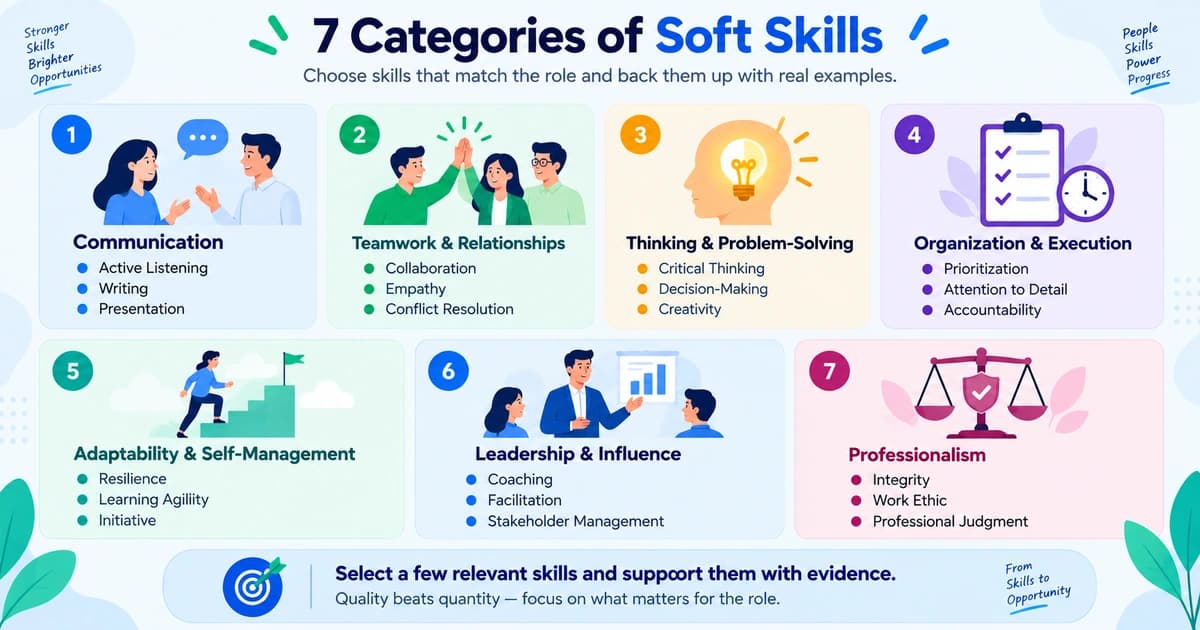
55 Soft Skills Examples by Category
The best soft skills for resume use depend on the role. Treat this soft
skills list as a selection tool, not a list to copy in full.
Communication
Written communication
Verbal communication
Active listening
Presentation skills
Persuasion
Negotiation
Constructive feedback
Audience awareness
Teamwork and Relationships
Collaboration
Empathy
Conflict resolution
Relationship building
Cross-functional teamwork
Cultural awareness
Diplomacy
Customer orientation
Thinking and Problem-Solving
Critical thinking
Analytical thinking
Problem-solving
Decision-making
Creativity
Curiosity
Strategic thinking
Resourcefulness
Organization and Execution
Time management
Prioritization
Attention to detail
Planning
Dependability
Accountability
Follow-through
Process improvement
Adaptability and Self-Management
Adaptability
Flexibility
Resilience
Stress management
Self-awareness
Initiative
Learning agility
Patience
Leadership and Influence
Leadership
Delegation
Coaching
Mentoring
Motivation
Facilitation
Stakeholder management
Change management
Professionalism
Integrity
Discretion
Work ethic
Ownership
Professional judgment
Inclusiveness
Ethical reasoning
If someone asks for 3 examples of soft skills, communication,
problem-solving, and adaptability form a useful general answer. For an
application, however, choose skills supported by your experience and the
job description.
Searches for a list of soft skils contain a common misspelling. The
correct phrase is list of soft skills, but neither version should be
copied into a resume without considering relevance.
What really happens
75% of all resumes never reach human recruiters. Applicant Tracking Systems (ATS) reject them automatically — often by mistake
Critical Thinking, Emotional Intelligence, Active Listening, and Work Ethic
Top performers do not necessarily possess a different list of traits.
They apply specific soft skills consistently and make their behavior
visible. Critical thinking helps them evaluate evidence and find
creative solutions. High emotional intelligence supports self-awareness,
active listening, an adaptable communication style, and positive
relationships. A strong work ethic turns those qualities into dependable
action.
They clarify outcomes. They ask what success looks like before starting.
They prioritize well. They prioritize tasks, distinguish urgent work from important work, and explain tradeoffs early.
They communicate proactively. They share progress, risks, and decisions before others have to ask.
They seek feedback. They use specific input to improve rather than treating it as a personal attack.
They take ownership. They acknowledge mistakes, correct them, and improve the process.
They adapt without losing standards. They change the plan while protecting quality, ethics, and safety.
They help the team succeed. They share knowledge, improve processes, maintain a positive attitude, and make collaboration easier.
These soft skills strengths are credible because colleagues can observe
them. "Resilient" is a claim; reorganizing a delayed launch while
maintaining stakeholder alignment is evidence.
Most Important Soft Skills by Industry: 10 Examples
Industry or role
Valuable soft skills
Why they matter
Technology
Problem-solving, collaboration, learning agility
Teams must troubleshoot, explain decisions, and adopt new tools.
Data and analytics
Critical thinking, attention to detail, communication
Analysts must validate information and translate findings for others.
Finance
Integrity, accuracy, judgment
Errors and weak controls can create financial and compliance risks.
Healthcare administration
Empathy, discretion, organization
Staff handle sensitive information and coordinate time-critical work.
Marketing
Creativity, audience awareness, adaptability
Customer needs, channels, and campaign results change quickly.
Sales
Active listening, persuasion, resilience
Strong sellers understand needs and respond professionally to rejection.
Customer support
Customer service skills, patience, empathy
Representatives must resolve issues and support customer retention.
Human resources
Discretion, communication, inclusiveness
HR handles confidential matters and differing perspectives.
Projects require coordination across deadlines and interests.
Executive support
Judgment, reliability, diplomacy
Assistants manage sensitive information and competing priorities.
These are starting points, not universal rules. The top soft skills for
a position depend on its responsibilities, seniority, and required
industry knowledge. Read the vacancy and select the most relevant skill
examples.
Soft Skills for Resume: How to Showcase Soft Skills
The strongest soft skills for resume use appear in context. To showcase
soft skills effectively, connect them to decisions, actions, and
results. Do not fill the skills section with personality adjectives or
claim every item from a list of soft skills for resume use.
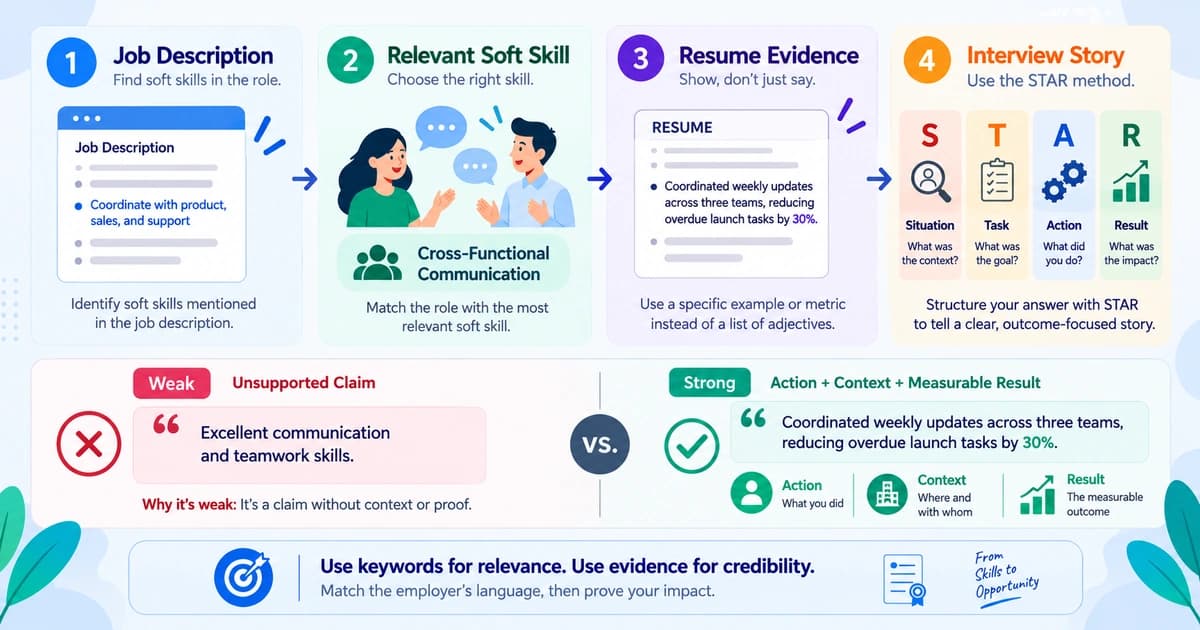
1. Read the Job Description
Look for soft skills keywords and behavioral requirements. "Coordinate
with product, sales, and finance" points to cross-functional
collaboration. "Manage several deadlines" suggests prioritization and
organization. Note the job title and use the employer's wording only
when it accurately describes you. This alignment can also help applicant
tracking systems connect relevant resume skills with the vacancy, but
keywords cannot replace evidence.
2. Select Three to Five Relevant Skills
What are good soft skills to put on a resume? The answer depends on the
position. Good soft skills for resume targeting are relevant, specific,
and supported by evidence. A customer success applicant may prioritize
empathy and conflict resolution; a financial analyst may choose critical
thinking and attention to detail.
3. Prove Them in Experience Bullets
Compare these soft skills resume examples:
Weak: Excellent communication and teamwork skills.
Strong: Coordinated weekly updates across product, sales, and
support teams, resolving ownership gaps and reducing overdue launch
tasks by 30%.
The second soft skills on resume example proves communication,
collaboration, organization, and initiative without listing them as
unsupported claims.
4. Use the Skills Section Selectively
A concise resume soft skills list can support relevant keywords,
especially for entry-level candidates. If you use a dedicated skills
section, combine soft and hard skills rather than creating a long
personality inventory:
This is a stronger soft skills resume example than "Friendly, motivated,
hardworking." Avoid unsupported labels such as team player. A
dedicated skills section should contain only the right soft skills and
hard skills for the role. Labels such as Core Competencies or
Professional Skills may read more naturally than Soft Skills.
5. Reinforce Skills in the Summary
Use one or two qualities in your professional summary and link them to
scope or results:
Customer success specialist with excellent communication skills and a
record of resolving complex issues across a portfolio of 80 B2B
accounts.
That is how to write soft skills on resume sections naturally: connect
the quality to work. The same principle answers searches such as how to
write soft skills in resume and what are soft skills on a resume.
Resume Soft Skills Examples for Different Career Levels
Entry-Level
Led a five-person capstone team, assigned milestones, documented
decisions, and delivered the final presentation two days early.
This demonstrates leadership, teamwork, organization, and reliability
without requiring formal management experience.
Mid-Career
Facilitated requirements workshops with operations and engineering,
resolving conflicting priorities and securing approval for a revised
workflow.
Manager
Coached six team members through monthly development plans, helping four
earn expanded responsibilities within one year.
These resume soft skills examples work because the reader sees an action
and outcome. Use this model when choosing soft skill examples for resume
bullets, examples of soft skills for resume sections, or a broader soft
skills list for resumes.
How to Showcase Soft Skills in Job Interviews
The interview process gives you more room to demonstrate judgment and
strong communication skills. Hiring managers use job interviews to
compare how candidates think, collaborate, and respond to challenges
after technical qualifications have been established. Prepare short STAR
stories covering teamwork, conflict, change, pressure, feedback, and
mistakes.
For each story, explain:
Situation: the relevant context;
Task: your responsibility;
Action: what you personally did and why;
Result: the outcome and what you learned.
If asked about adaptability, do not say only, "I adapt quickly."
Describe a change, your assessment, how you reprioritized, whom you
informed, and what happened. Interview behavior matters too: listen to
the complete question, ask for clarification, organize the answer, and
avoid blaming colleagues. This evidence can distinguish you from other
candidates.
Learning Soft Skills Through Active Learning: 10 Quick Tips
Soft skills training can introduce useful frameworks, but learning soft
skills requires active learning, practice, feedback, and personal
development. Select one in demand skill that matters for your target
role, then use the following steps to build soft skills:
Ask a manager or colleague for feedback on one specific behavior.
Choose one skill to practice for 30 days instead of improving everything at once.
Record a presentation and review its clarity, pace, and structure.
Summarize meetings in writing to strengthen listening and follow-through.
Before solving a conflict, restate the other person's concern accurately.
Use a priority framework and communicate tradeoffs before deadlines slip.
Volunteer to facilitate a meeting or coordinate a small project.
Keep a weekly record of decisions, feedback, mistakes, and improvements.
Observe a colleague who handles the target behavior well and ask about their process.
Measure progress through outcomes such as fewer revisions, faster decisions, or clearer handoffs.
Training can provide techniques, but improvement requires reflection and
repetition in real situations.
How to Use Soft Skills During a Job Search
Do not try to become "excellent at all soft skills." Identify the
abilities that matter for your target role, collect evidence, and
practice explaining it clearly. During a job search, your resume, cover
letter, interview answers, references, and daily behavior should
reinforce the same professional story. In today's competitive job
market, credible examples can move you closer to your dream job than
unsupported claims.
When researching soft skills for resumes, you may encounter
near-identical phrases such as soft skills resume, resume soft skills,
soft skills for resume examples, soft skills examples for resume, soft
skill resume examples, soft skills resume examples, and resume soft
skills examples. Queries such as soft skills to put on resume and soft
skills to list on resume express the same intent: which qualities belong
on a resume and how to present them. The answer is to list fewer skills
and prove more of them.
Get better job matches
Add your resume to improve your matches. Even a draft or outdated resume can significantly improve job recommendations
A few examples are communication, teamwork, adaptability,
problem-solving, and attention to detail. Other soft skills, including
empathy, leadership, and accountability, may be more relevant for
certain roles.
What Are Some Soft Skills to Put on a Resume?
Choose three to five skills directly connected to the job description
and your experience. The best soft skills for resume targeting are the
ones you can demonstrate through achievements, projects, or feedback.
Should I List Soft Skills on a Resume?
You may list soft skills on resume sections when they are relevant, but
do not rely on the list alone. Place evidence in experience bullets, the
summary, projects, and interview stories. This approach works better
than copying a generic list of soft skills for resume use.
What Is the Difference Between Hard and Soft Skills?
Hard skills are teachable technical abilities, such as SQL or
accounting. Soft skills shape how you apply knowledge, work with people,
and respond to problems. Most jobs require both.
What Are the Best Soft Skills for a Resume?
There is no universal set. Communication, problem-solving, adaptability,
teamwork, and reliability are broadly useful, but the best soft skills
for resume success match the specific vacancy and appear in credible
examples.
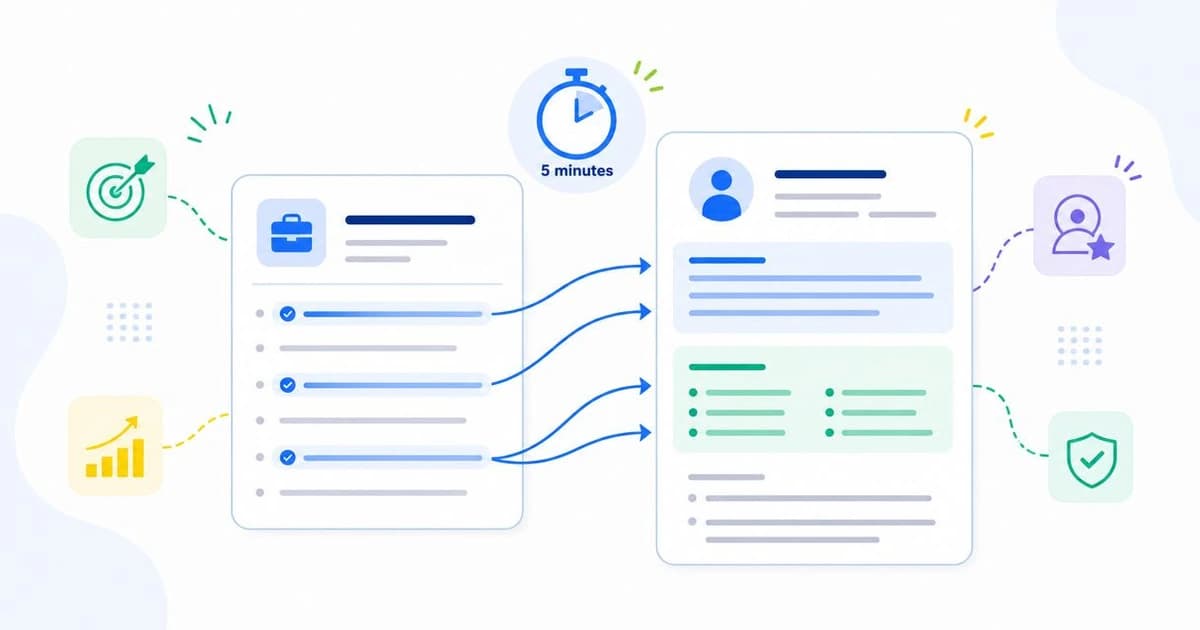
A five-minute routine for tailoring a resume: pull the real requirements out of the posting, change four things, and leave the rest alone. Includes a priority table, a master resume workflow, and a reusable checklist.
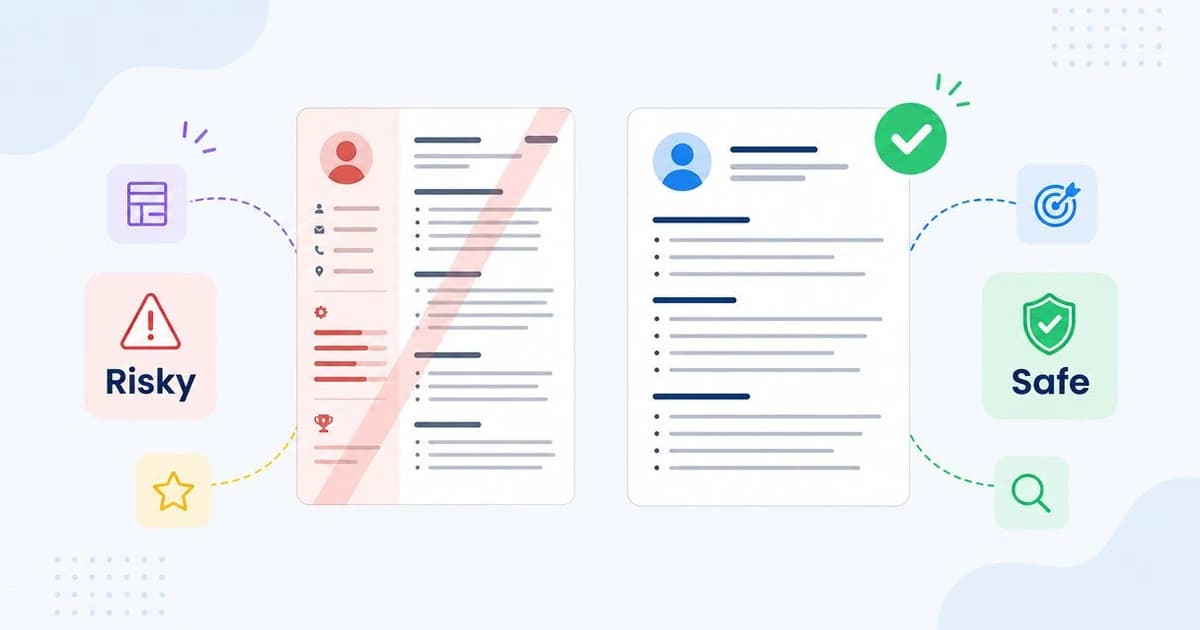
A practical look at what makes a resume template parse cleanly, with five layouts you can rebuild yourself and a 12-point check to run before you apply.
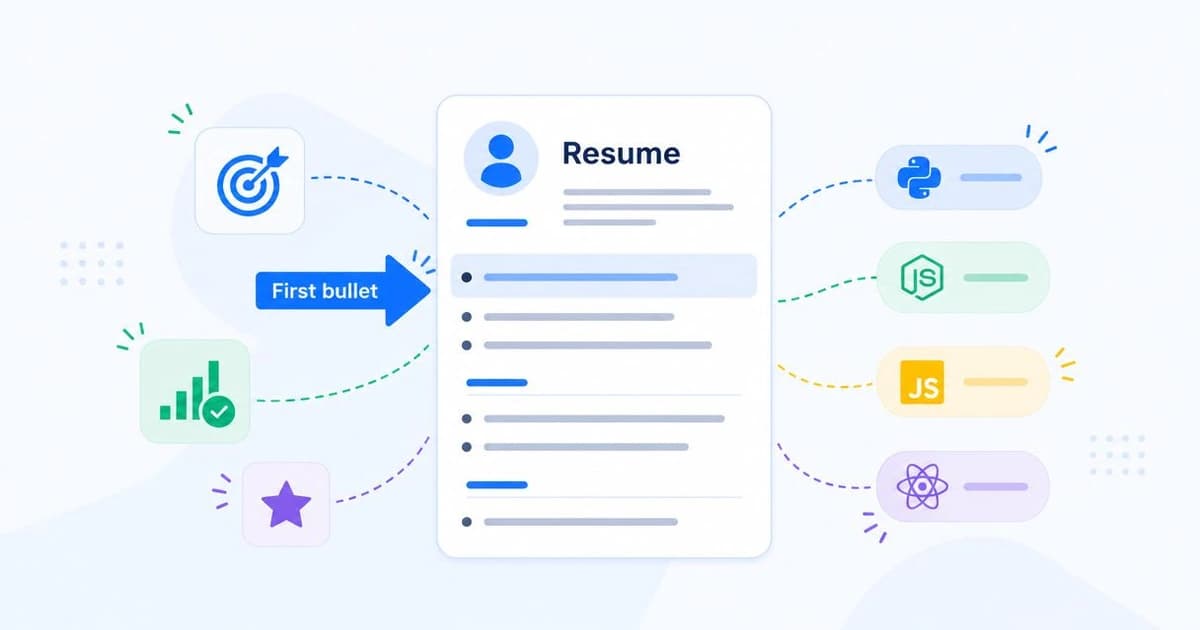
A recruiter-side look at how a software engineer resume is screened in seconds, with first-bullet keyword sets for full-stack, backend, and frontend roles. Includes a before-and-after bullet rewrite and a signal-to-line mapping table.
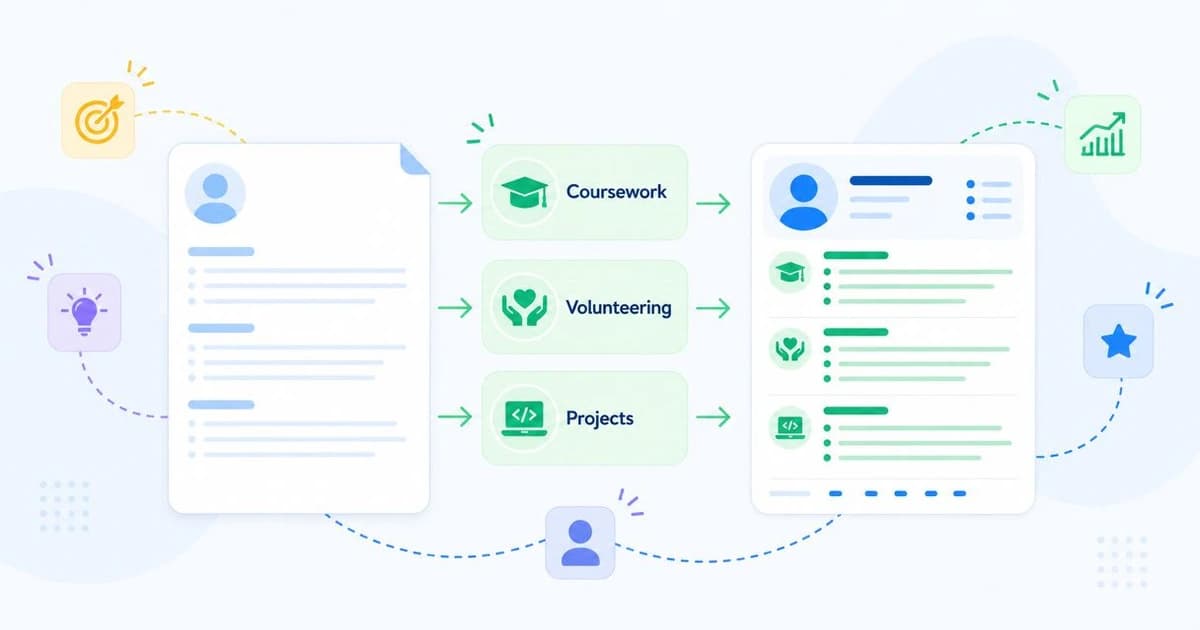
What to put on a first resume when you have never held a paid job, including 20 things that count as experience and a section order for four different situations.